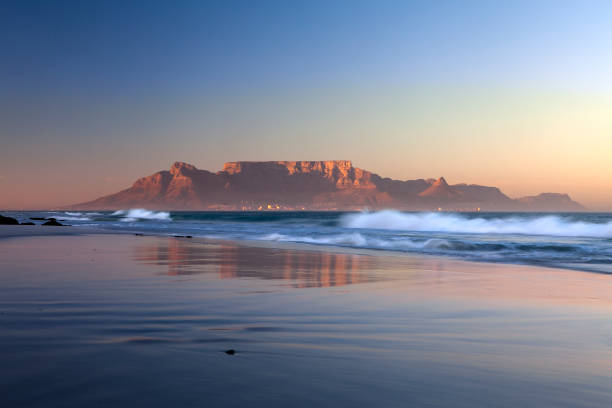
There is no view in South Africa quite like standing on the summit of Table Mountain and looking out over the full sweep of the Cape Peninsula — the city below, the two oceans meeting at the horizon, Robben Island a dark smudge in the blue Atlantic, and the long spine of mountains running south toward Cape Point. It is one of those views that actually delivers on its reputation. Table Mountain is genuinely, emphatically worth it.
Voted one of the New Seven Wonders of Nature in 2011, Table Mountain rises 1,086 metres above sea level and its distinctive flat top — nearly three kilometres wide — is one of the most recognisable landforms on earth. It has been a navigational landmark for sailors for five centuries, appearing in ships’ logs dating to the first European voyages around the Cape in the late 1400s. The indigenous Khoikhoi people called it Hoerikwaggo — “mountain in the sea.”
The Cable Car
The Table Mountain Aerial Cableway has been carrying visitors to the summit since 1929, making it one of the oldest cable car systems in the world. The current cars — introduced in 1997 and upgraded since — rotate 360 degrees during the five-minute ascent, giving every passenger a full panoramic view of the mountain, the city and the ocean as they rise.
The lower cable station is on Tafelberg Road, reached by car or by the popular Red Bus hop-on hop-off service from the city centre. The upper station sits at 1,067 metres and connects directly to the summit plateau via walkways.
Practical information: The cable car runs daily, weather permitting, from approximately 08:00 to 19:30 (hours vary by season). Adult tickets cost around R490 return. Children under 4 travel free. Booking online in advance is strongly recommended — queues at the lower station can be very long in peak season, and pre-booked tickets allow you to bypass the queue.
The Weather: The Most Important Thing to Understand
Table Mountain has its own microclimate, and it can change within minutes. The mountain creates its own clouds — the famous “tablecloth,” a thick blanket of orographic cloud that rolls over the summit when the south-easterly wind is blowing. On a clear morning, the tablecloth can descend within an hour, reducing visibility on the summit to near zero and causing the cable car to suspend operations for safety.
The cable car does not operate in high winds, heavy rain or low visibility. If you arrive at the lower station and the cable car is closed, check the Table Mountain Aerial Cableway website or app — they update conditions regularly and will indicate when operations are expected to resume.
The best strategy: check the forecast the night before, arrive early (the first cars of the day often have the clearest views and shortest queues), and have a backup plan for your day if the mountain is closed. Our guides at Mzansi Safari Tours monitor the mountain conditions constantly and will adjust your itinerary on the day if needed — this is one of the practical advantages of having a local guide rather than booking independently.
What to Do on the Summit
The summit plateau is larger than most visitors expect — roughly 3 km long and up to 1.5 km wide in places. There are well-marked walking trails of varying lengths across the plateau, from a short 30-minute loop with excellent viewpoints to longer hikes toward Maclear’s Beacon, the highest point on the mountain at 1,086 metres. The views change at every turn.
Table Mountain National Park — of which the mountain is the centrepiece — is one of the most biodiverse areas on the planet. The Cape Floral Region, which covers the mountain and its surroundings, is one of the world’s six floral kingdoms and the smallest — yet it contains more plant species per square kilometre than the Amazon rainforest. Around 2,200 plant species grow on Table Mountain alone, many of them endemic to this specific mountain. The fynbos — the distinctive fine-leaved shrubland of the Cape — covers the plateau in a tapestry of proteas, ericas and restios that is spectacular year-round.
Wildlife on the summit includes dassies (rock hyraxes) — small, furry mammals that look like large guinea pigs and are, improbably, the closest living relatives of the elephant. They are completely tame and will approach visitors confidently, particularly near the cable car station where they have become accustomed to people. Do not feed them.
The summit restaurant and café offers meals and snacks with what is quite possibly the best lunch view in South Africa. There is also a gift shop at the upper cable station.
Hiking Up: The Walking Routes
For those who prefer to earn their summit, there are several hiking routes up the mountain, ranging from moderate to strenuous. The most popular walking route is the Platteklip Gorge trail — a clear, well-maintained path up a ravine on the front face of the mountain. It takes approximately two hours at a comfortable pace and is suitable for reasonably fit walkers. The views from the gorge are outstanding, and the path connects to the summit plateau from which you can take the cable car down.
The India Venster route offers a slightly more adventurous alternative, with some scrambling over rocks and excellent views across to Lion’s Head. Skeleton Gorge, on the back of the mountain above Kirstenbosch, is a beautiful but more demanding route through indigenous forest.
Important: Do not underestimate Table Mountain. People die on this mountain every year — mostly from hypothermia, dehydration or falls. Always carry water (at least 2 litres per person), wear proper footwear, bring a wind and rain layer regardless of the morning weather, tell someone where you are going, and do not hike alone. Download the Table Mountain National Park trail map before you go.
Lion’s Head: The Perfect Companion
The conical peak immediately to the west of Table Mountain is Lion’s Head — 669 metres, and one of the most rewarding hikes in Cape Town. The circular route (approximately 5 km) takes 2 to 3 hours and involves some exhilarating scrambling with chains and ladders on the upper section. The 360-degree view from the summit — Table Mountain on one side, the Atlantic and Camps Bay on the other, and the city spread out below — is extraordinary. Full moon hikes on Lion’s Head are a Cape Town institution, though they require early booking through local hiking groups.
When to Visit
Table Mountain is open year-round, but the summer months (November to March) bring the south-easterly wind and the tablecloth cloud, which can close the cable car for days at a time. The shoulder seasons — April to May and September to October — offer the most consistently good weather, with autumn in particular bringing stable, warm, windless days and wonderful clarity.
All Mzansi Safari Tours Cape Town packages include a Table Mountain cable car ticket as part of the tour price. We monitor conditions in real time and will advise on the best day and time to visit based on the forecast throughout your stay.