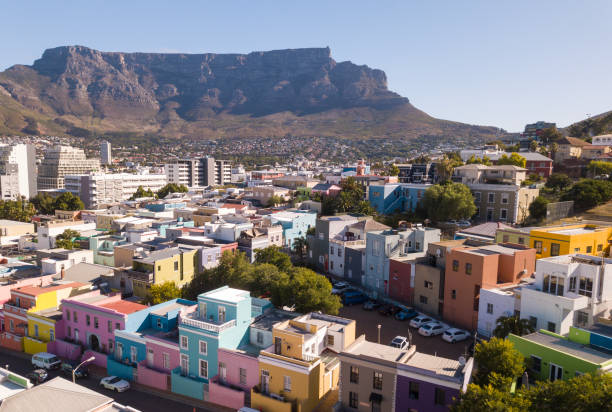
There is a moment, when you turn off Buitengracht Street and begin climbing the steep cobblestoned lanes of Bo-Kaap, when Cape Town reveals a face that has no equivalent anywhere else in Africa. The houses — brilliant yellow, vivid pink, sky blue, lime green, burnt orange — rise up the slopes of Signal Hill in close-packed rows, their colours so intense they seem almost to vibrate against the deep blue of the Cape sky. This is one of the most photographed neighbourhoods on the continent, and one of the most historically significant.
But Bo-Kaap is far more than a backdrop for photographs. It is a living community with roots stretching back to the earliest years of the Cape Colony — a neighbourhood shaped by slavery, exile, Islamic faith and the extraordinary cultural synthesis that emerged from all three. To walk its streets with any understanding is to walk through 350 years of Cape Town’s most layered history.
The Origins: Slavery and the Cape Malay Community
Bo-Kaap — the name means “above the Cape” in Afrikaans — was established in the 1760s, when the Dutch East India Company began renting out houses in this area on the lower slopes of Signal Hill. The first residents were not European settlers but enslaved people and political exiles brought to the Cape from across the VOC’s trading empire: from Indonesia, Malaysia, India, Sri Lanka, Madagascar and the East African coast.
These people came from vastly different places and spoke different languages, but they shared two things: the experience of enslavement and, increasingly, the Islamic faith. Islam was the thread that bound the community together. The Cape Muslim community — often referred to as Cape Malay, though this is a historical oversimplification since the community’s origins were far more diverse — built the first mosque in sub-Saharan Africa here. The Auwal Mosque on Dorp Street, founded in 1794, still stands and still functions today.
When slavery was abolished at the Cape in 1834, many formerly enslaved people settled permanently in Bo-Kaap, buying or building the terraced houses that still line its streets. The cobblestones — worn smooth by two centuries of foot traffic — date from this era.
The Colours: A Tradition with Deep Roots
The famous colours of Bo-Kaap have a history that is somewhat contested but deeply meaningful. For much of the apartheid era, the houses were painted white — this was a municipal requirement. When the restrictions were lifted in the 1990s, residents began painting their houses in vivid colours as a celebration of freedom, of identity reclaimed after decades of suppression.
Some residents also link the tradition of colour to older Islamic practices of adorning a home after the completion of the Hajj — the pilgrimage to Mecca. Whatever the precise origin, the colours today are a statement: this neighbourhood has its own identity, its own culture, and it will not be made uniform.
Each colour, according to local tradition, has meaning — yellow for warmth and prosperity, green for Islam and growth, blue for the sky and the ocean that brought the community’s ancestors here in chains. Whether one accepts these specific interpretations or not, the overall effect is of a community that has chosen, consciously, to be seen.
The Architecture
Beyond the colours, the architecture of Bo-Kaap is worth examining closely. The houses are predominantly Cape Georgian and Cape Malay in style — a fusion that developed organically at the Cape and exists nowhere else in the world quite like this. The stoeps (verandas), the flat roofs with their parapets, the shuttered windows and the distinctive doorways all reflect this hybrid architectural heritage.
The neighbourhood’s grid of narrow streets — Wale Street, Chiappini Street, Rose Street, Longmarket Street — was laid out in the 18th century and remains largely unchanged. Walking them feels genuinely historical in a way that few urban neighbourhoods in Southern Africa can match.
The Bo-Kaap Museum on Wale Street, housed in one of the oldest buildings in the area (built around 1763), offers an excellent introduction to the community’s history and domestic life. It contains period furniture, household objects and photographs that bring the neighbourhood’s past to life.
Food: The Cape Malay Kitchen
Cape Malay cuisine is one of South Africa’s most distinctive and beloved cooking traditions, and Bo-Kaap is its heartland. Developed over centuries from the fusion of Indonesian spice-trade cooking, Dutch pantry staples, indigenous Cape ingredients and the creative necessity of enslaved people feeding themselves on whatever was available, it is a cuisine of extraordinary complexity and warmth.
Bobotie — a spiced minced meat dish with a custard topping, fragrant with turmeric, curry leaves, cinnamon and dried fruit — is the most internationally recognised dish and often described as South Africa’s national dish. Bredie is a slow-braised meat and vegetable stew, typically made with waterblommetjies (water hyacinth flowers, indigenous to the Cape) or tomatoes. Koeksisters — not to be confused with the Afrikaner version — are syrup-soaked braided doughnuts that are at once crispy and yielding, spiced with aniseed, cardamom and ginger.
Several restaurants in and around Bo-Kaap offer authentic Cape Malay cooking. The Bo-Kaap Kombuis on Augustus Street is a long-established favourite, serving traditional dishes in a house that has the feel of being invited into someone’s home — because, essentially, you have been.
The Call to Prayer
Bo-Kaap is home to ten mosques — an extraordinary density for a neighbourhood of this size — and five times a day, the adhan (call to prayer) echoes across the streets. For visitors, this is one of the most atmospheric aspects of the neighbourhood. Early morning, just before sunrise, the Fajr prayer call rises over the cobblestones as the light begins to warm the coloured facades. It is a sound that roots you in this specific place, this specific community, this specific history.
The two most historically significant mosques are the Auwal Mosque on Dorp Street — the oldest mosque in South Africa — and the Nurul Islam Mosque on Longmarket Street. Both welcome respectful visitors outside of prayer times.
Gentrification and the Fight to Stay
In recent years, Bo-Kaap has become the centre of a significant and sometimes bitter debate about gentrification. As Cape Town’s property market has boomed and the neighbourhood’s fame has grown, developers have bought up properties and long-term residents have faced sharply rising rates and rents. The construction of a luxury apartment block in 2018 triggered sustained community protests, with residents blockading the construction site for months.
The community’s resistance has been fierce and partially successful. Bo-Kaap was granted Heritage Protection status, which limits certain types of development. But the pressure continues, and the question of who gets to live in this neighbourhood — whether its residents can afford to stay in the place their families have occupied for generations — remains unresolved.
This tension is part of the story too. Bo-Kaap is not a museum piece. It is a neighbourhood where real people live, worship, cook, raise families and fight for their right to remain. Visiting it with that understanding — with respect for its living community, not just its photogenic streets — is the only way to visit it honestly.
Visiting Bo-Kaap
Bo-Kaap is a short walk or quick drive from Cape Town city centre, situated at the base of Signal Hill. It is easily combined with a visit to the V&A Waterfront, the Company’s Garden or the Castle of Good Hope. The best time to visit is in the morning, when the light is soft and the streets are quieter.
All Mzansi Safari Tours Cape Town packages include a guided visit to Bo-Kaap with a local guide who can speak to the neighbourhood’s history from the inside. We do not simply drive past — we walk the streets, enter the museum, and if timing allows, visit a local home for a demonstration of Cape Malay cooking. It is, consistently, one of the highlights of every Cape Town itinerary we run.